Intelligence Brief
Sake rice export forecasts best conducted in the fields
Hotter summers are a significant quality risk behind premium Japanese sake. Brewing quality takes shape in the weeks after the rice flowers, and those weeks now land inside the hottest summers Japan has on record.
Premium sake is more valuable than it used to be
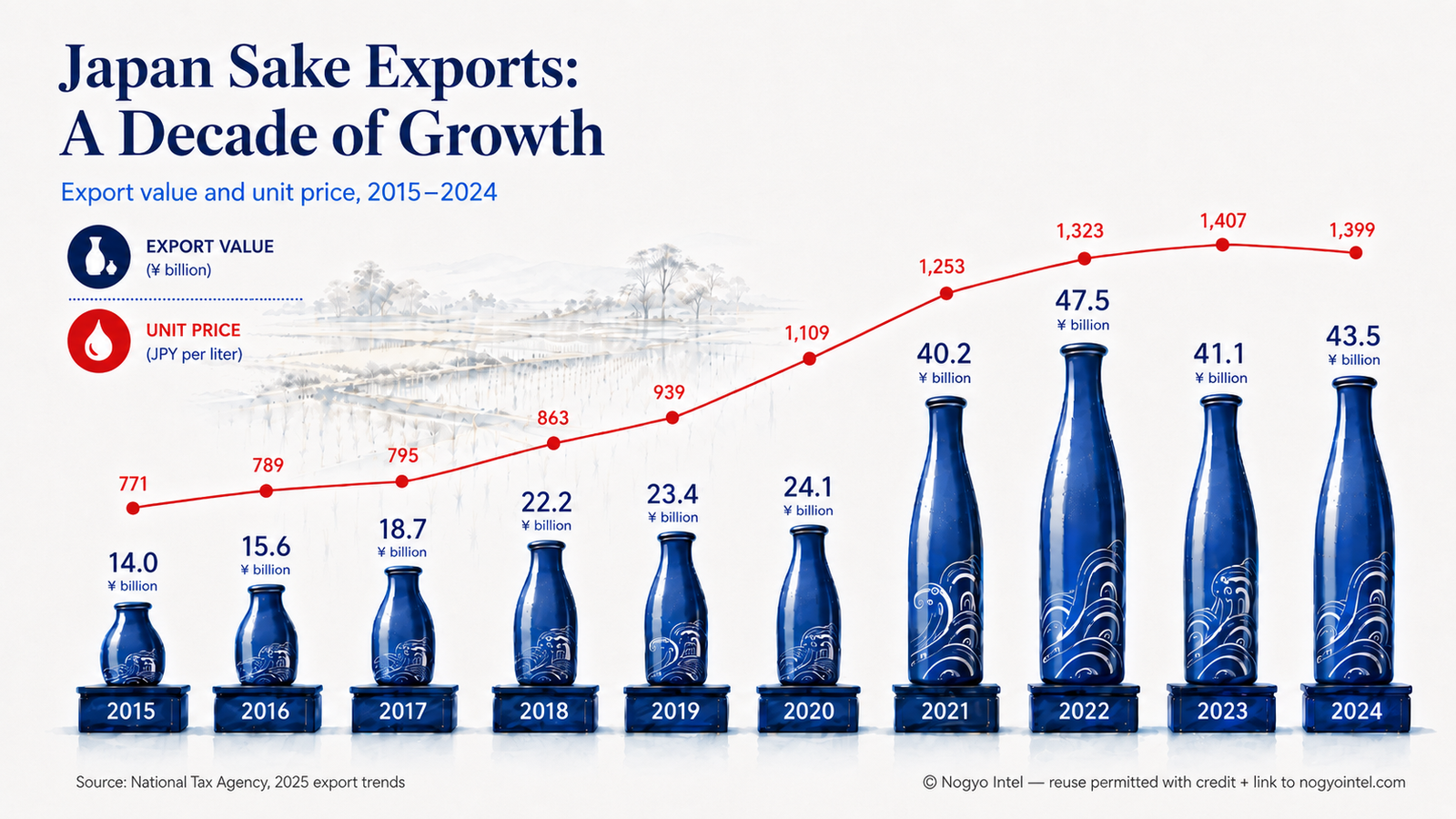
Japan’s sake export market has become much more valuable over the past decade. National Tax Agency data shows sake exports rose from ¥14.011 billion in 2015 to ¥43.456 billion in 2024, while export unit value increased from ¥771/L to ¥1,399/L over the same period. The 2025 export update shows sake exports rising again to ¥45.879 billion, up 5.6% from 2024. (National Tax Agency, 2025 export trends; NTA, 2025 sake handbook export data)
That is the demand-side story. Premium and exportable sake now carries higher market value, stronger origin expectations, and a greater need for consistency. A foreign buyer may see rising export value and assume the supply side is straightforward. The field-side picture is more specific: premium sake depends on rice that performs in the brewery, and tonnage figures alone cannot tell you whether it will.
This is where the raw material itself becomes worth tracking. For exporters, distributors, premium restaurants, and investors watching Japanese sake, the useful question runs deeper than how much sake Japan sells overseas: whether the rice behind that value stays consistent, contractable, and suitable for premium brewing.
Blue farmland (青地, ao-chi) — farmland officially zoned for agricultural use under Japan’s Cropland Act, subject to the tightest conversion restrictions.
Sake rice and table rice answer to different markets
Sake rice and table rice are both Japanese rice, but they are different varieties judged by different markets.
Table rice is judged as food: appearance, texture, aroma, taste, and eating quality. Sake rice is judged as a brewing input. Brewers need rice that can be polished deeply, absorb water predictably, support koji-making, dissolve in the mash, and produce the intended flavor and body.
Japan has a dedicated word for this rice: 酒造好適米 (shuzō kōtekimai), or sake-brewing-suitable rice. What sets it apart is the 心白 (shinpaku), a soft, porous white core at the centre of the grain that absorbs water readily and helps it ferment evenly. That core has to survive heavy milling. Premium sake polishes the grain hard to strip the fats, proteins, and minerals in the outer layers, often down to a remaining 35–70% of the original kernel, against about 90% for rice eaten as food. (MAFF, sake-brewing rice quality material) Sake varieties are bred large, with a durable core, precisely so they can withstand heavy milling; table-rice varieties, smaller and polished only lightly, are not built for it.
Business readers new to the sake market can easily miss that difference. A report about Japan’s table-rice harvest, retail rice prices, or rice export volume does not automatically describe the supply conditions behind premium sake. For sake, the more relevant indicators include sake-specific export value, sake export unit value, sake-brewing rice production, variety-level demand, contracted availability, and whether the crop keeps the traits brewers need.
| Table rice | Sake rice | |
|---|---|---|
| Judged on | Eating quality | Brewery performance |
| Key traits | Appearance, taste, texture, aroma | Polishing, water absorption, solubility, fermentation |
| How heat damage shows up | Graded lower, sells for less | Lower yield, more sake lees, less consistent sake |
| What the market watches | Volume and consumer price | Variety, origin, contract supply, brewing quality |
How hotter summers are impacting the brewery
The risk begins with heat during the grain-filling and ripening period, when the kernel forms and brewing quality is set. This is no longer a future scenario. Japan has now had three record-hot summers in succession: the national summer temperature ran +1.76°C above the 1991–2020 average in both 2023 and 2024, then rose to +2.36°C in 2025, the highest since records began in 1898. The Meteorological Agency’s analysis panel adds that the warming is speeding up: the most recent 30-year trend is running about 3.8 times the long-term pace. (JMA, Japan summer temperature; JMA, 2025 extreme-heat analysis)
| Year | Summer temperature anomaly vs 1991–2020 | Rank since 1898 |
|---|---|---|
| 2025 | +2.36°C | 1st (record) |
| 2024 | +1.76°C | tied 2nd |
| 2023 | +1.76°C | tied 2nd |
| 2010 | +1.08°C | 4th |
| 2022 | +0.91°C | 5th |
This is not a run of unlucky years. The official national projection, 日本の気候変動2025 (Climate Change in Japan 2025, MEXT and the Meteorological Agency), expects Japan to keep warming for decades. By the end of the century the national average temperature is projected to run about 1.4°C higher under a 2°C-warming scenario and about 4.5°C higher under a high-emissions scenario, against late-twentieth-century levels, with Japan warming faster than the world as a whole. MAFF’s own crop modelling points the same way. Measured on table-rice grading, it projects national rice yield rising until around 2061–2080 and then turning to decline, with the share of chalky grain increasing from the 2040s and the area of top-grade rice shrinking as economic loss grows. (MEXT/JMA, Climate Change in Japan 2025; MAFF, agriculture and climate-change measures) Sake rice grows in the same fields and the same summers, so the same warming reaches it; its brewing-quality risk is therefore a long-term one.
That heat reaches the field at the worst moment. In Hyogo, which grows roughly 54% of Japan’s Yamada Nishiki (the benchmark rice for premium and competition-grade sake), prefectural data shows white immature grains increase once the average daily temperature in the 11–20 days after heading passes 26.5°C, a threshold recent summers cross more often. (MAFF Kinki, 2025 Yamada Nishiki high-temperature seminar material)
For brewers, this shows up as solubility: how readily the rice dissolves in the mash. MAFF’s sake-rice material notes that excessive ripening heat reduces it, so the rice yields less alcohol and more sake lees (酒粕, sakekasu), which raises cost. (MAFF, sake-brewing rice quality material)
The business chain looks like this:
| Stage | What heat can affect | Business impact |
|---|---|---|
| Field | Grain filling and ripening in the hot weeks after flowering | Quality risk starts before harvest |
| Grain | Shinpaku, fullness, cracking | Harder to polish, weaker as raw material |
| Brewery | How the rice dissolves and ferments | Less sake from the same rice, more lees, higher cost |
| Market | Premium-grade supply, cost, consistency | Tighter premium-grade supply, higher costs, less consistent quality for buyers |
A poor harvest shows up immediately in production volume, but brewing-quality problems are harder to spot from headline tonnage: a crop can hit its volume target and still cause trouble if the rice is less soluble, more prone to cracking, or less suited to premium brewing.
Heat can also change the grain’s core in some varieties, leaving it more likely to break during the deep polishing premium sake requires, and breakage means waste and higher cost. (J-STAGE, Ibaraki University / Nagano study on shinpaku and high-temperature ripening)
Where the quality risk is documented, and where it isn’t
The field-side risk varies by region and variety. This map answers two questions for anyone sourcing sake or sake rice: where is the rice you depend on concentrated, and how much do we actually know about its heat exposure? ‘Factor in now’ marks regions where the heat evidence and adaptation are documented enough to use in decisions today; ‘monitor’ marks concentration nodes where the evidence is still forming. The map shows what is documented rather than ranking climate risk. A ‘monitor’ region is under-studied, which is not the same as low-risk.
| Region and key variety | Production concentration | Heat evidence and adaptation | What it means |
|---|---|---|---|
| Hyogo (Yamada Nishiki) | 18,356 t of Japan’s 33,952 t of Yamada Nishiki (about 54%) | White immature grains rise above 26.5°C in days 11–20 after heading; adapting through planting-date maps and grain-diagnosis apps | Factor in now |
| Hiroshima (Hattan Nishiki 1, Hirokei lines) | All of Japan’s Hattan Nishiki 1 (1,756 t) | Heat-ripening quality loss documented enough to drive a breeding programme; breeding for heat tolerance, high polishing, and solubility, with pilot brewing | Factor in now |
| Niigata (Gohyakumangoku, Koshitanrei) | 8,706 t of Japan’s 17,469 t of Gohyakumangoku (about 50%), plus 1,146 t of Koshitanrei | Sake-rice-specific heat evidence thin; 2023 table-rice damage is not sake-rice failure; no adaptation programme documented | Monitor |
| Okayama (Omachi) | 2,920 t of Japan’s 2,965 t of Omachi (about 98%) | Heat-specific evidence thin; no adaptation programme documented | Monitor |
| Yamagata (Dewa Sansan, Yukimegami) | All of Japan’s Dewa Sansan (1,497 t) | Heat-specific evidence thin; no adaptation programme documented | Monitor |
| Akita (Akita Sake Komachi) | All of Japan’s Akita Sake Komachi (2,536 t) | Heat evidence under-sourced; no adaptation programme documented | Monitor |
| Kyoto (Iwai) | Production not separately reported; appears in MAFF export-share data | Heat evidence under-sourced; no adaptation programme documented | Monitor |
MAFF’s 2024 crop production estimate confirms the concentration behind this map. Yamada Nishiki was the largest sake-rice variety at 33,952 t, followed by Gohyakumangoku at 17,469 t. Together, those two varieties made up a little over half of estimated sake-brewing rice production. (MAFF, 2024 sake-rice production estimate)
The production figures throughout the map come from MAFF’s 2024 sake-rice data; the ‘factor in now’ and ‘monitor’ calls are Nogyo Intel’s own assessment of how well each region’s heat exposure and adaptation are documented to date.
The export link: which rice streams feed overseas sake?
Most sake rice is still used for the broader domestic and total sake market, not only for export sake. But MAFF’s demand survey gives a rare look at which region-and-variety streams are connected to exported sake. (MAFF, 2025 sake-rice demand survey, export-linked raw-material table)
Export-linked rice demand comes in two shapes. Some rice streams supply large volumes to exported sake; others send a high share of their crop into export products even at smaller volumes. Both are worth tracking for buyers, distributors, and exporters mapping the raw material behind premium sake.
The top export-linked raw-material rice streams by volume in MAFF’s 2025 demand survey were:
| Rank | Region + variety | Total rice demand | Rice for export sake | Share to export |
|---|---|---|---|---|
| 1 | Hyogo Yamada Nishiki | 11,506 t | 694 t | 6.0% |
| 2 | Niigata Gohyakumangoku | 7,620 t | 445 t | 5.8% |
| 3 | Fukui Gohyakumangoku | 1,971 t | 152 t | 7.7% |
| 4 | Okayama Omachi | 1,407 t | 126 t | 8.9% |
| 5 | Nagano Miyama Nishiki | 1,952 t | 123 t | 6.3% |
These demand-survey volumes differ from the production estimates in the map above, because the two MAFF surveys measure different things: the rice brewers demand versus the rice growers produce. The export-linked quantities also cover only the sake makers that answered the export-share question, so the true figures may be higher.
This table does not show that exports dominate the sake-rice market. It shows something narrower and more useful: some of Japan’s most important sake-rice streams already sit inside the export supply chain. For foreign buyers, this connects overseas premium sake demand back to specific rice varieties and production regions.
What Japan is doing, and where the gaps are
Japan’s response runs on two levels. Nationally, MAFF works from a Climate Change Adaptation Plan, revised in 2023, and publishes an annual survey of heat damage and the measures prefectures most commonly report using: heat-tolerant varieties, water management, and fertilizer timing. NARO, the national agricultural research body, breeds heat-tolerant varieties and models the planting shifts that blunt ripening heat. (MAFF, climate-change adaptation in agriculture)
That national machinery is built around table rice. Its yardsticks are table-rice grades, and its flagship heat-tolerant varieties are eating rice. Sake-rice breeding tends to sit with prefectural institutes and large brewers, because regions compete on the identity of their local rice. Hiroshima’s heat-tolerant Hirokei lines, Niigata’s Koshitanrei, and Yamagata’s Yukimegami were each developed by their own prefecture rather than through a national programme. (Hiroshima Prefecture, sake-rice breeding research; JA Zennoh Yamagata, on Yukimegami)
The clearest cases are Hyogo and Hiroshima.
In Hyogo, Yamada Nishiki adaptation is farm-side and data-driven. MAFF/Kinki materials point to delayed planting to avoid high ripening temperatures, optimal transplanting-date maps, and smartphone tools such as Rice Cam Y and Grains Cam for grain filling, fertilization diagnosis, and cracked-rice risk. The same material says recent post-heading heat has made white immature grains easier to generate. (MAFF Kinki, 2025 Yamada Nishiki high-temperature seminar material)
In Hiroshima, adaptation is research-side. Hiroshima Prefecture says its sake-rice development goals included high yield, tolerance to high-temperature ripening damage, shinpaku size suitable for high polishing, and solubility at least equal to Yamada Nishiki. The prefecture developed Hirokei Sake 44 and Hirokei Sake 45 using a simplified digestibility test and high-temperature ripening evaluation. (Hiroshima Prefecture, sake-rice breeding research)
Adaptation is spreading across three fronts:
| Front | What adaptation looks like | Business implication |
|---|---|---|
| Farm-side | planting timing, water management, fertilization, harvest timing, grain diagnosis | better field management and quality prediction |
| Research-side | heat-tolerant sake-rice lines, digestibility testing, variety evaluation | new supply options, but adoption depends on brewer acceptance |
| Brewery-side | soaking, steaming, koji, fermentation, procurement adjustments | process flexibility, but not a full substitute for reliable rice quality |
The open question is whether sake rice can ride on a response built for table rice. Heat-tolerant sake-rice options are emerging, but switching is commercially constrained when a brewery’s identity depends on a specific variety or region. For breeders, agri-tech firms, and investors, that gap between a table-rice-shaped safety net and sake rice’s identity constraints is where both the risk and the opportunity sit.
What business readers should watch
Export numbers show what is happening on the sales side: how much sake Japan is selling overseas and how much value the market is attaching to each liter. They do not show the field-side condition of the rice used to make that sake. A forecast built on volume and export value can stay green while a quality problem is already building in the field, surfacing first as higher cost and tighter premium-grade supply rather than as a fall in tonnage.
For that, buyers need to watch sake-brewing rice production, variety-level demand, regional concentration, and quality readings such as solubility, cracking, and grain filling. MAFF’s annual sake-rice demand survey exists because growers and brewers need supply-demand coordination before planting decisions are made. (MAFF, 2025 sake-rice demand summary)
| Reader | What to watch |
|---|---|
| Brewers | solubility, sakekasu, polishing yield, cracked grains, contracted rice quality |
| Exporters | premium SKU consistency, rice-origin messaging, unit value, export-linked varieties |
| Foreign buyers / distributors | regional variety dependence, supply consistency, producer transparency |
| Agri-tech firms | grain diagnosis, heat-risk prediction, water and crop-timing tools |
| Breeding / seed companies | heat tolerance, digestibility, shinpaku stability, brewer acceptance |
| Investors / food companies | premium sake supply resilience, regional concentration, adaptation maturity |
Bottom line
Premium sake’s global story is still positive. Exports have grown, unit value is higher than a decade ago, and Japanese sake remains closely tied to origin, craft, and rice identity.
The field-side question is more specific: can Japan continue producing enough brewing rice with the quality traits premium sake depends on? For foreign buyers, exporters, and agriculture businesses, the question worth tracking is whether the rice behind that growth stays consistent, contractable, and suitable for premium brewing.