Sake rice export forecasts best conducted in the fields
Hotter summers are a significant quality risk behind premium Japanese sake. Brewing quality takes shape in the weeks after the rice flowers, and those weeks now land inside the hottest summers Japan has on record.
Premium sake is more valuable than it used to be
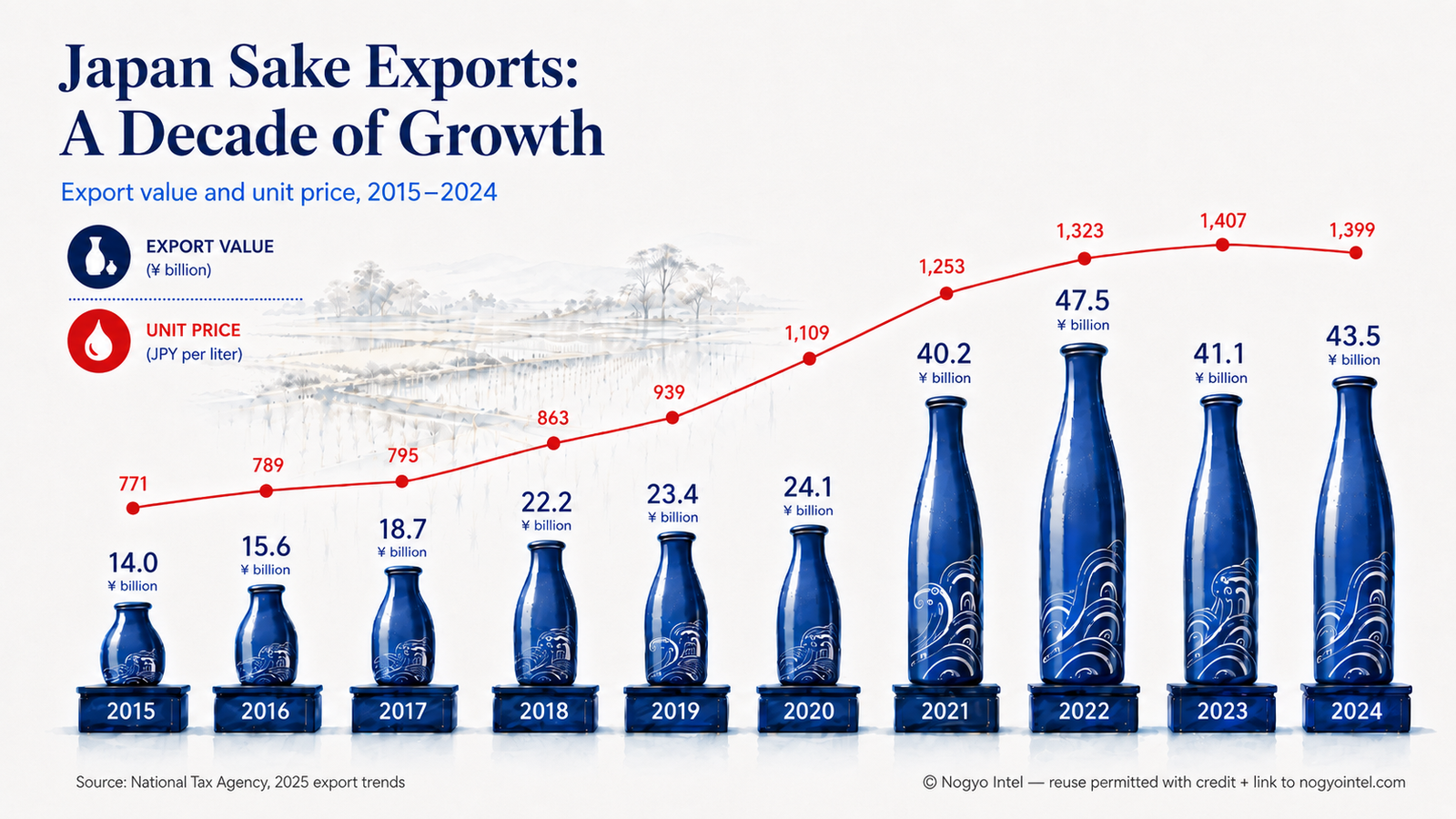
Japan’s sake export market has become much more valuable over the past decade. National Tax Agency data shows sake exports rose from ¥14.011 billion in 2015 to ¥43.456 billion in 2024, while export unit value increased from ¥771/L to ¥1,399/L over the same period. The 2025 export update shows sake exports rising again to ¥45.879 billion, up 5.6% from 2024. (National Tax Agency, 2025 export trends; NTA, 2025 sake handbook export data)
Japan can harvest the expected tonnage of sake rice and still produce a weaker brewing crop. Production figures measure the weight of rice harvested. They do not show whether the grains filled properly, can survive deep polishing, absorb water consistently or dissolve efficiently in the mash. If those traits deteriorate, breweries may produce less usable sake from the same volume of rice while facing more breakage, more sake lees and higher costs. That makes the condition of the previous autumn’s crop part of the export outlook, even when the headline harvest volume appears adequate.
The brewing traits that heat puts at risk
Sake is made from both specialist sake-brewing varieties and ordinary rice varieties also grown for eating. Specialist varieties such as Yamada Nishiki are particularly valuable in premium brewing because their larger grains, lower protein levels and internal structure make them better suited to deep polishing, koji production and controlled fermentation. (Japan Sake and Shochu Makers Association, brewing processes)
The distinction matters here because summer heat can weaken the qualities brewers depend on. Rice may still be harvested and counted in production totals even when the grains have filled poorly, become more prone to breaking during polishing or behave less consistently during brewing.
Broad rice prices can therefore affect brewery costs, while the condition and availability of specialist varieties create an additional concern for premium producers. The useful question is not simply how much rice was harvested, but how much of it retained the qualities required in the brewery.
Timing also matters when turning crop conditions into a sake forecast. Rice planted in spring is normally harvested in autumn, and the new brewing season begins soon afterward. Brewing takes about two months, and much of the resulting sake matures for roughly six to twelve months before sale. Some fresh sake is released earlier, while deliberately aged sake may be held for several years. (Japan Sake and Shochu Makers Association, the four seasons of sake brewing; JSS, sake terminology)
A weak or heat-damaged crop can therefore affect brewery costs and production yields within months, and influence many releases in the following year. The effect on retail prices may take longer or vary by producer because breweries also work with contracted rice, existing inventories, different release schedules, and products aged for different periods.
How heat damage moves from field to brewery
Heat does not affect the crop equally throughout the growing season. The most important period comes during grain filling and ripening, when the kernels develop many of the traits that later determine how the rice performs in the brewery. For major sake-rice varieties, that vulnerable window commonly falls in late summer, placing grain development directly inside Japan’s hottest weeks. The summers of 2023, 2024 and 2025 produced the three highest readings in Japan’s temperature record, which begins in 1898. (Japan Meteorological Agency, Japan summer temperature; Japan Meteorological Agency, 2025 extreme-heat analysis)
| Year | Summer temperature anomaly vs 1991–2020 | Rank since 1898 |
|---|---|---|
| 2025 | +2.36°C | 1st (record) |
| 2024 | +1.76°C | tied 2nd |
| 2023 | +1.76°C | tied 2nd |
| 2010 | +1.08°C | 4th |
| 2022 | +0.91°C | 5th |
This exposure is expected to continue. Climate Change in Japan 2025, published by the Ministry of Education, Culture, Sports, Science and Technology and the Japan Meteorological Agency, projects further warming under every assessed emissions scenario. (MEXT/JMA, Climate Change in Japan 2025)
Hyogo supplied 54.8% of Japan’s Yamada Nishiki shipments in 2023. Research from the prefecture found that white immature grains increase when the average temperature during days 11–20 after heading—the emergence of the rice head—exceeds 26.5°C. Separate research found that high temperatures during ripening can alter the grain’s internal structure in some sake-rice varieties, making the rice more vulnerable to breakage during deep polishing. (Hyogo Prefecture, 2023 Yamada Nishiki shipment data; MAFF Kinki, 2025 Yamada Nishiki high-temperature seminar material; Ibaraki University and Nagano Agricultural Experiment Station, study of high-temperature effects on sake-rice grain structure)
Heat can also make the rice less soluble in the mash. MAFF notes that lower solubility can produce less alcohol and more sake lees (酒粕, sakekasu) from the same amount of rice, reducing usable output and raising production costs. (MAFF, sake-brewing rice quality material)
| Stage | What heat can affect | What it can mean |
|---|---|---|
| Field | Grain filling and ripening in the hot weeks after flowering | Quality risk starts before harvest |
| Grain | Internal grain structure, grain development and cracking | Harder to polish, weaker as raw material |
| Brewery | How the rice dissolves and ferments | Less sake from the same rice, more lees, higher cost |
| Market | Premium-grade supply, cost, consistency | Potential pressure on supply, costs and consistency for buyers |
Where the quality risk is documented, and where it isn’t
The field-side risk varies by region and variety. This table answers two questions for anyone sourcing sake or sake rice: where is the rice you depend on concentrated, and how much do we actually know about its heat exposure? ‘Factor in now’ marks regions where the heat evidence and adaptation are documented enough to use in decisions today; ‘monitor’ marks concentration nodes where the evidence is still forming. The table shows what is documented rather than ranking climate risk. A ‘monitor’ region is under-studied, which is not the same as low-risk.
| Region and key variety | Production concentration | Heat evidence and adaptation | What it means |
|---|---|---|---|
| Hyogo (Yamada Nishiki) | 18,356 t of Japan’s 33,952 t of Yamada Nishiki (about 54%) | White immature grains rise above 26.5°C in days 11–20 after heading; adapting through planting-date maps and grain-diagnosis apps | Factor in now |
| Hiroshima (Hattan Nishiki 1, Hirokei lines) | All of Japan’s Hattan Nishiki 1 (1,756 t) | Heat-ripening quality loss documented enough to drive a breeding programme; breeding for heat tolerance, high polishing, and solubility, with pilot brewing | Factor in now |
| Niigata (Gohyakumangoku, Koshitanrei) | 8,706 t of Japan’s 17,469 t of Gohyakumangoku (about 50%), plus 1,146 t of Koshitanrei | Sake-rice-specific heat evidence thin; 2023 table-rice damage is not sake-rice failure; no adaptation programme documented | Monitor |
| Okayama (Omachi) | 2,920 t of Japan’s 2,965 t of Omachi (about 98%) | Heat-specific evidence thin; no adaptation programme documented | Monitor |
| Yamagata (Dewa Sansan, Yukimegami) | All of Japan’s Dewa Sansan (1,497 t) | Heat-specific evidence thin; no adaptation programme documented | Monitor |
| Akita (Akita Sake Komachi) | All of Japan’s Akita Sake Komachi (2,536 t) | Heat evidence under-sourced; no adaptation programme documented | Monitor |
| Kyoto (Iwai) | Production not separately reported; appears in MAFF export-share data | Heat evidence under-sourced; no adaptation programme documented | Monitor |
MAFF’s 2024 crop production estimate confirms the concentration shown in this table. Yamada Nishiki was the largest sake-rice variety at 33,952 t, followed by Gohyakumangoku at 17,469 t. Together, those two varieties made up a little over half of estimated sake-brewing rice production. (MAFF, 2024 sake-rice production estimate)
The production figures in the table come from MAFF’s 2024 sake-rice data; the ‘factor in now’ and ‘monitor’ calls are Nogyo Intel’s own assessment of how well each region’s heat exposure and adaptation are documented to date.
The export link: which rice streams feed overseas sake?
Most sake rice is still used for the broader domestic and total sake market, not only for export sake. But MAFF’s demand survey gives a rare look at which region-and-variety streams are connected to exported sake. (MAFF, 2025 sake-rice demand survey, export-linked raw-material table)
Export-linked rice demand comes in two shapes. Some rice streams supply large volumes to exported sake; others send a high share of their crop into export products even at smaller volumes. Both are worth tracking for buyers, distributors, and exporters mapping the raw material behind premium sake.
The top export-linked raw-material rice streams by volume in MAFF’s 2025 demand survey were:
| Rank | Region + variety | Total rice demand | Rice for export sake | Share to export |
|---|---|---|---|---|
| 1 | Hyogo Yamada Nishiki | 11,506 t | 694 t | 6.0% |
| 2 | Niigata Gohyakumangoku | 7,620 t | 445 t | 5.8% |
| 3 | Fukui Gohyakumangoku | 1,971 t | 152 t | 7.7% |
| 4 | Okayama Omachi | 1,407 t | 126 t | 8.9% |
| 5 | Nagano Miyama Nishiki | 1,952 t | 123 t | 6.3% |
These demand-survey volumes differ from the production estimates in the table above, because the two MAFF surveys measure different things: the rice brewers demand versus the rice growers produce. The export-linked quantities also cover only the sake makers that answered the export-share question, so the true figures may be higher.
This table does not show that exports dominate the sake-rice market. It shows something narrower and more useful: some of Japan’s most important sake-rice streams already sit inside the export supply chain. For foreign buyers, this connects overseas premium sake demand back to specific rice varieties and production regions.
What Japan is doing, and where the gaps are
Japan’s response runs on two levels. Nationally, MAFF works from a Climate Change Adaptation Plan, revised in 2023, and publishes an annual survey of heat damage and the measures prefectures most commonly report using: heat-tolerant varieties, water management, and fertilizer timing. NARO, the national agricultural research body, breeds heat-tolerant varieties and models the planting shifts that blunt ripening heat. (MAFF, climate-change adaptation in agriculture)
That national machinery is built around table rice. Its yardsticks are table-rice grades, and its flagship heat-tolerant varieties are eating rice. Sake-rice breeding tends to sit with prefectural institutes and large brewers, because regions compete on the identity of their local rice. Hiroshima’s heat-tolerant Hirokei lines, Niigata’s Koshitanrei, and Yamagata’s Yukimegami were each developed by their own prefecture rather than through a national programme. (Hiroshima Prefecture, sake-rice breeding research; JA Zennoh Yamagata, on Yukimegami)
In Hyogo, Yamada Nishiki adaptation is farm-side and data-driven. MAFF/Kinki materials point to delayed planting to avoid high ripening temperatures, optimal transplanting-date maps, and smartphone tools such as Rice Cam Y and Grains Cam for grain filling, fertilization diagnosis, and cracked-rice risk. The same material says recent post-heading heat has made white immature grains easier to generate. (MAFF Kinki, 2025 Yamada Nishiki high-temperature seminar material)
In Hiroshima, adaptation is research-side. Hiroshima Prefecture says its sake-rice development goals included high yield, tolerance to high-temperature ripening damage, shinpaku size suitable for high polishing, and solubility at least equal to Yamada Nishiki. The prefecture developed Hirokei Sake 44 and Hirokei Sake 45 using a simplified digestibility test and high-temperature ripening evaluation. (Hiroshima Prefecture, sake-rice breeding research)
Adaptation is taking three forms:
| Front | What adaptation looks like | Business implication |
|---|---|---|
| Farm-side | planting timing, water management, fertilization, harvest timing, grain diagnosis | better field management and quality prediction |
| Research-side | heat-tolerant sake-rice lines, digestibility testing, variety evaluation | new supply options, but adoption depends on brewer acceptance |
| Brewery-side | soaking, steaming, koji, fermentation, procurement adjustments | process flexibility, but not a full substitute for reliable rice quality |
The open question is whether sake rice can ride on a response built for table rice. Heat-tolerant sake-rice options are emerging, but switching is commercially constrained when a brewery’s identity depends on a specific variety or region. For breeders, agri-tech firms, and investors, that gap between a table-rice-shaped safety net and sake rice’s identity constraints is where both the risk and the opportunity sit.
Indicators to watch
Export numbers show what is happening on the sales side: how much sake Japan is selling overseas and how much value the market is attaching to each liter. They do not show the field-side condition of the rice used to make that sake. A forecast built on volume and export value can stay green while a quality problem is already building in the field, surfacing first as higher cost and tighter premium-grade supply rather than as a fall in tonnage.
For that, buyers need to watch sake-brewing rice production, variety-level demand, regional concentration, and quality readings such as solubility, cracking, and grain filling. MAFF’s annual sake-rice demand survey exists because growers and brewers need supply-demand coordination before planting decisions are made. (MAFF, 2025 sake-rice demand summary)
| Reader | What to watch |
|---|---|
| Brewers | solubility, sakekasu, polishing yield, cracked grains, contracted rice quality |
| Exporters | premium SKU consistency, rice-origin messaging, unit value, export-linked varieties |
| Foreign buyers / distributors | regional variety dependence, supply consistency, producer transparency |
| Agri-tech firms | grain diagnosis, heat-risk prediction, water and crop-timing tools |
| Breeding / seed companies | heat tolerance, digestibility, shinpaku stability, brewer acceptance |
| Investors / food companies | premium sake supply resilience, regional concentration, adaptation maturity |
Bottom line
Premium sake’s global story is still positive. Exports have grown, unit value is higher than a decade ago, and Japanese sake remains closely tied to origin, craft, and rice identity.
The central supply question is whether Japan can continue producing enough brewing rice with the quality traits premium sake requires. Foreign buyers, exporters, and agriculture businesses should track whether that rice remains consistent, available under contract, and suitable for premium brewing.
Disclaimer and advisory support
This article is for general informational purposes and does not constitute legal, investment or commercial advice. Data, market conditions and policy measures may change. Nogyo Intel provides research and advisory support on Japanese agricultural policy, market development and business strategy. For project-specific support, contact us.